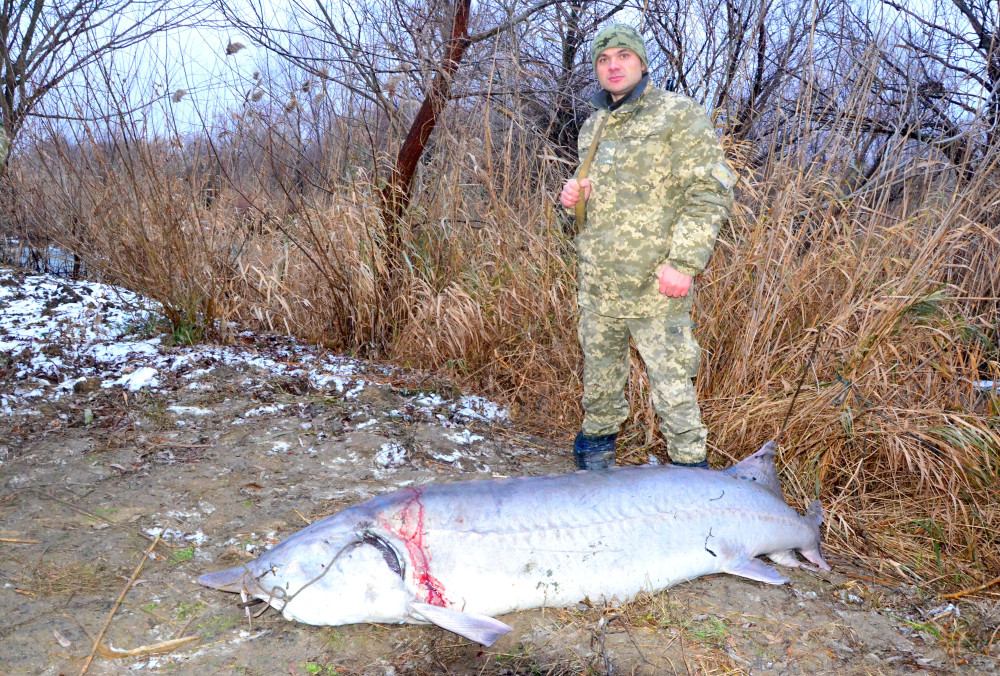
Beluga poached in Ukraine 2016 found by a Vylkovo border police officer, © Danube Biosphere Reserve / M. Yakovlev
Authorities seized at least 6.5 tonnes of illegal sturgeon meat and whole fish over the past ten years
Despite strict legal protection, sturgeons, the world's most endangered group of animals, continue to fall victim to wildlife crime in Europe, warns a new WWF report. At least 3,366 sturgeon were affected by documented wildlife crime in the Lower Danube between 2016 and 2025. The findings provide the most comprehensive assessment to date of the scale of poaching and illegal sturgeon trade in the region.
In the Net of Poachers: Ten Years of Documented Wildlife Crime Targeting Sturgeons in the Lower Danube Region (2016-2025) analyses official enforcement data from Bulgaria, Romania and Ukraine. It is the world's only regularly updated cross-border assessment of sturgeon-related wildlife crime. This year also marks ten consecutive years of WWF compiling and analysing official seizure data from the three countries most critical to the survival of the Lower Danube's remaining native sturgeon populations.
"Illegal fishing and trafficking continue to pose a serious threat to the recovery of Danube sturgeons. Every sturgeon lost to poaching is a setback for populations already on the brink of extinction. Strong enforcement and cross-border cooperation are essential if these iconic fish are to survive," commented Beate Striebel, WWF Sturgeon Initiative Lead. "We would like to thank the national enforcement authorities for their continued cooperation over the past decade. Their commitment is essential to strengthening regional efforts to combat wildlife crime and protect the last remaining wild sturgeon populations," she added.
Using an improved methodology, WWF produced its most comprehensive estimate to date of the number of sturgeons affected by documented wildlife crime. The approach combined cases where authorities reported only the total weight of confiscated sturgeon with those where the exact number of fish was recorded, converting reported weights into estimated numbers of individuals. Even so, the estimate remains a conservative minimum, as many illegal catches inevitably go undetected or unreported.
The report documents 509 confirmed wildlife crime cases involving sturgeons or targeted illegal gear over the ten-year period. Romania accounted for 235 cases, Bulgaria for 175, and Ukraine for 99. However, WWF cautions that the number of recorded cases should not be interpreted as a direct measure of poaching pressure, as detection depends heavily on enforcement capacity, reporting practices, and access to affected areas.
The documented decline of registered illegal cases from Ukraine unfortunately does not mark a declining overall trend, as WWF attributes this decrease to Russia's war against Ukraine, which has restricted access to important fishing grounds and significantly constrained enforcement activities in key parts of the Danube Delta and the Black Sea coast.
The report confirms that all four remaining Danube sturgeon species continue to be affected by wildlife crime: sterlet, stellate sturgeon, Russian sturgeon and beluga. Among documented cases, sterlet accounted for the largest share of affected individuals, while seizures also included exceptionally large beluga sturgeons measuring more than two metres in length and weighing up to 200 kilograms.
In total, authorities also confiscated at least 263 kilograms of illegal caviar, approximately 6.5 tonnes of sturgeon meat and whole fish, and large quantities of illegal fishing gear.
One of the report's most striking findings comes from Bulgaria, where authorities confiscated 1,250 illegal karmaci hook lines over the past decade. This prohibited fishing method is particularly cruel, using long lines fitted with numerous large hooks that snag fish rather than catch them by the mouth, often leaving them severely injured and struggling for hours or even days. Together, the seized lines measured more than 45 kilometres and contained approximately 54,000 hooks capable of catching sturgeon. Despite the scale of these confiscations, only 25 sturgeon were officially seized in Bulgaria over the ten-year period. According to WWF, this stark discrepancy highlights the need for further analysis of enforcement practices and reporting systems, rather than suggesting low poaching pressure.
The report also identifies persistent geographic hotspots where illegal activities overlap with critical sturgeon habitats, including Tulcea County in Romania, Odesa Oblast in Ukraine, and Vratsa Oblast in Bulgaria.
Despite decades of legal protection and permanent fishing bans throughout the Lower Danube and Black Sea, poaching and illegal trade continue to undermine recovery efforts for species that have survived since the age of dinosaurs. WWF calls for strengthened cross-border cooperation, improved intelligence sharing between enforcement agencies, enhanced monitoring and reporting systems, stronger prosecution of wildlife crime, and continued investment in protecting the last remaining wild sturgeon populations before further losses become irreversible.